Friday, June 19, 2009

June 21, 2009 - "In The Same Boat"

scripture: Mark 4:35-41; 1 Samuel 17:1a, 4-11, 32-46a, 49


Living in the Midwest, we know something about storms. When your school’s athletic teams are called the Cyclones, you know that you live in a place that has some serious weather.


And we pay attention to weather. We are weather watchers. As we got ready to go to the Iowa Cubs game in Des Moines Friday night, the weather people were forecasting thunderstorms and 80 mph wind. We were paying attention to the weather.


I have been taking the bus to the church about once a week, and when you take public transportation, you pay even more attention to the weather. It’s no fun waiting for the bus in the rain. It’s even less fun being caught in a storm.


There are storms, and then there are storms. Our scripture from Mark this morning is a dramatic story of the disciples out on the boat with Jesus, crossing the lake. Jesus says, “Let’s go over to other side of the lake.” This doesn’t sound like too much. But this is not the way things were done in those days. With small boats and the ever-present possibility of storms suddenly coming up on the lake, they would typically sail around the edges of the lake. This way they could always see the land; and if a storm came up they would be able to get to shore quickly.


Normally, a boat trip on the Sea of Galilee for those who lived along the western and northwestern shore meant going from one town to another along that shore. The Golan Heights tower over the eastern shore, providing few landing places. Wherever their exact location, to go across to the other side – which means not only traveling physically to the other side of the lake but crossing over religiously from Jewish to Gentile territory – to go to “the other side” meant going almost the full length of the Sea of Galilee during the night. It was quite a journey to begin in the evening with the considerable possibility of a storm roaring down from the Golan Heights.


And apparently that is what happened. Jesus, tired from the work of the day, goes to sleep in the boat. He is unconcerned. And a storm comes up suddenly. Winds are gusting, waves are lashing against the boat and it starts to take on water. The disciples are scared to death. There is no storm cellar out on the lake. “Wake up, Jesus! Don’t you even care that we are going to die?”


And then, our scripture from the Old Testament is the familiar story of David and Goliath. Goliath challenges the Israelite army, and the whole army seems paralyzed by fear. Saul had become king in part because he was head and shoulders above everyone else. He would have seemed the logical one to battle Goliath, but he seems as scared as the rest. The shepherd boy David, with his stones and slingshot, is the only one willing to battle the giant.


Two powerful stories. What do these stories have in common? The common theme is fear. The disciples are afraid. They say to Jesus, “Don’t you care that we are dying in this storm?” And Jesus says, “Why are you afraid?”


And then you have this giant, Goliath, screaming out at the Israelite army, taunting them. Various scholars have translated the description of Goliath into modern measurement and estimates range from about 6’8” to 9’ in height. He was a big guy, a scary guy. No wonder nobody wanted to take him on. The texts reads, “When Saul and all Israel heard these words of the Philistine, they were dismayed and greatly afraid.”


Two powerful stories, both of which hinge on fear. Well, we shouldn’t be surprised. A lot of the stories in scripture have to do with fear. One of the most common phrases found in scripture is “be not afraid.”


Out of curiosity, I got on my computer and searched the words fear, afraid, terrified, and frightened in the Bible. Forms of these words appear 853 times. Throw in anxiety and distress and you are up to 1057. Basically, take away the theme of fear and we would be minus much of the Bible.


At the beginning of Genesis, after eating from the tree of Life, Adam tries to hide from God. God asks why, and Adam says, “I was afraid.” Abraham goes to Egypt with his wife Sarah and tries to pass her off as his sister – because she is beautiful and Abraham is afraid Egyptian men will want her. After stealing the birthright from his brother, Jacob has not seen his brother Esau in years. They are about to meet again, and Jacob is “afraid and greatly distressed.” Joseph’s brothers go to Egypt - and they are afraid of him. Moses after it is discovered he had killed an Egyptian? Afraid. And then at the burning bush? He hides his face, afraid.


Later, after the Goliath episode, Saul is afraid of David and David is afraid of Saul. On and on it goes.


In Luke chapter 1, an angel appears to Zechariah. He is terrified. The angel says, “Be not afraid.” Then an angel appears to Mary, and tells her, “Do not be afraid.” In Luke chapter 2, angels appear to shepherds, who are – guess what? – terrified, and the angels say, “Do not be afraid.” Later in that chapter, Jesus is now 12 years old, and his parents are on their way home from the temple in Jerusalem when they can’t find him. They are – what? – afraid. Filled with anxiety.


Peter and James and John at the Transfiguration? Terrified. Pilate when the crowds want Jesus executed? Afraid. Herod around John the Baptist? Afraid. The disciples when they see Jesus walking on water? Terrified. Even Jesus in the Garden of Gethsemane is “deeply grieved”and “anguished.” Joseph of Arimathea buries Jesus’ body – he was a follower of Jesus, but a secret one – because he was afraid. After the resurrection, the disciples are meeting behind locked doors – because they are afraid. After Paul is converted on the road to Damascus, other Christians are not just skeptical, they are afraid. And later in Acts, an angel says to Paul, “Do not be afraid.”


Both the David and Goliath story and the story of the disciples in the storm have to do with fear. But they not only have that in common with one another, they have that in common with a huge chunk of the Bible. Almost all the characters in scripture at some point are described as being afraid.


What do these stories have in common? Fear. But more than that, what do we have in common with these stories? Fear. And what do we have in common with one another? Well, a lot of things, including fear.


When it comes to fear, we are all in the same boat. We are in the same boat with Jesus and the disciples.


A few years ago, the crew from a Japanese fishing boat was rescued from the Sea of Japan. But when the authorities questioned the crew about what had caused their boat to sink, the authorities immediately put all of the crew members in jail. They all claimed that a cow had fallen from the sky, struck their boat dead center, shattering the hull, and causing the boat to sink within a matter of minutes. The authorities, of course, were not about to believe that explanation. They threw the crew into jail, figuring that they must have been operating the vessel under the influence of alcohol or drugs to have come up with a story like that.


The crew remained in jail for several weeks, until one day the Russian Air Force informed the Japanese authorities that that fishing boat crew was telling the truth. It seems that a cow had wandered onto the edge of an airstrip in Siberia. So the Russians forced the cow into the plane’s cargo bay and took off, figuring that they would be set with a good supply of beef for quite some time. But apparently that crew wasn’t prepared for just how angry that cow would get. The cow began to storm and thrash about inside of the plane until finally, to save the aircraft and themselves, at about 30,000 feet, the crew shoved the cow out of the cargo hold as they were flying over the Sea of Japan. And it just happened that that fishing boat was right beneath them.


When you go out to sea, you can never be entirely sure what will happen. It’s usually not a cow falling from the sky, but adversity can come without any warning.


Our lives are whipped with wave after wave of adversity. There is no escaping it. And the natural reaction is fear.


Many have been battered by economic storms in recent months. I know several folks who have lost their jobs after years of service. Just as many are hanging on, fearful of what the future may hold.


Others are struggling with health issues, facing a future that is uncertain, and it is scary.


Still others are worried about children who seem to be following paths that lead to heartache.


There is no lack of things to worry about, things to be fearful over. Things big and small. Terrorism. Crime. Global warming. The cost of education. Swine flu. Strangers. People who are different. Spiders. Heights. Clowns.


Craig Loscalzo shared that his father, who passed away a few years ago, was a big man, six foot two, two hundred and some-odd pounds. He had always seemed to be a pillar of strength. Six months before he died, they were going to do some tests, and Craig went to be with him. When he got to the hospital, they were just wheeling his dad back from a lung biopsy. His stepmother stepped out of the room to talk to a nurse. Craig had never seen his father so frightened before. He said, “Dad, what’s the matter?” He said, “I’m scared.” Craig asked, “What are you scared of?” And his dad said, “I’m scared because I don’t know.”


That encapsulates it for a lot of us. “I’m scared because I don’t know.”


Fear has always resonated with us, especially “I’m scared because I don’t know.” It has been true since the time of Adam. And isn’t letting up. It seems that there is more and more to be afraid of, more and more opportunities to be “scared because I don’t know.” Much of our politics feeds on fear. You will lose your social security or be taxed to death or be forced to give up freedom or your guns or the socialists will take over or the fascists will take over.


Much of our economics feeds on fear. You won’t fit in if you don’t have the right consumer goods. Somebody came around door to door the other day selling educational software. “Do you want your child to fall behind?” was the pitch. All about fear. “The markets are unsafe – invest with us.” Or “The markets will rebound – do you want to take a chance on not being invested?”


And we have to admit that more than a little religion revolves around fear. Not just fear of hell, which is a longtime tradition, but fear of not being good enough, fear of not being acceptable.


Maybe more of an issue for us is, “How does the Church confront a changing culture?” There is genuine fear for the future as demographic trends bend away from involvement in church and congregations struggle with issues of vitality and ministry. We certainly struggle with these questions.


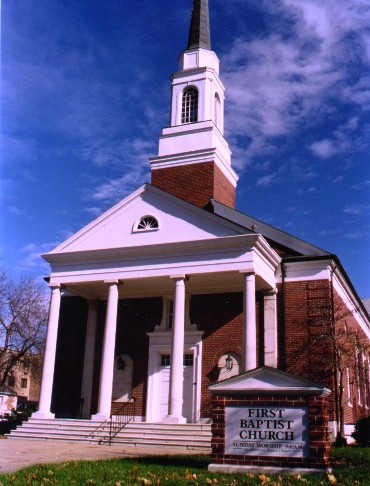
Churches vary in the terms they use for parts of their building. In historic terminology, the entry area is the narthex, the front is the chancel, and the main part of the church where we gather to worship is the nave. We generally call it the sanctuary, but it can also be called the nave. In Latin, the word nave means ship. A ship or boat has long been a symbol for the church. We are all in the boat together with Jesus. And this boat, like our own individual lives, is rocked and challenged by storms and waves that may threaten to sink us.


When it comes to the many fears that threaten us, it is important to remember who is with us in the boat. The disciples said, “Jesus, don’t you care? Don’t you care that we are going to die?” But Jesus was right there with them. He calmed the storm. And he said, “Why are you afraid? Do you still have no faith?”


Jesus had healed a man with a withered hand. He had healed a leper. He had healed Peter’s mother-in-law and many others. He had cast our many demons. They had heard his preaching and teaching. They had spent time with Jesus. But still they were lacking in faith.


We can be the same way. God has been with us before. God has been with us all along. Jesus has been there, helping us through the hard times, seeing us through the storms. But it is still difficult not to give in to fear.


In those times of anxiety and doubt and worry, we need to remember that we are in the boat together. As the church, we are to care for each other and encourage each other and support one another. And Jesus is right there in the boat with us.


E. Stanley Jones wrote,

I am inwardly fashioned for faith, not for fear. Fear is not my native land; faith is. I am so made that worry and anxiety are sand in the machinery of life; faith is the oil. I live better by faith and confidence than by fear, doubt and anxiety. In anxiety and worry, my being is gasping for breath--these are not my native air. But in faith and confidence, I breathe freely--these are my native air. A John Hopkins University doctor says, “We do not know why it is that worriers die sooner than the non-worriers, but that is a fact.” But I, who am simple of mind, think I know; we are inwardly constructed in nerve and tissue, brain cell and soul, for faith and not for fear. God made us that way. To live by worry is to live against reality.


In a similar vein, Harry Emerson Fosdick wrote:

Fear imprisons, faith liberates;
Fear paralyzes, faith empowers;
Fear disheartens, faith encourages;
Fear sickens, faith heals;
Fear makes useless, faith makes serviceable;
And, most of all, fear puts hopelessness at the heart of all,
While faith rejoices in its God.


Some years ago, comedian and actor Tim Allen being interviewed by James Lipton. After talking about Allen’s career, his ups and downs, his struggles with addiction and so forth, Lipton asked a series of short questions. In one of them, he asked what Tim Allen thought God would say to him when he got to heaven.

Allen thought for a moment, and then responded, “I told you there was nothing to be afraid of.”

Which is basically a paraphrase of Psalm 27: The Lord is my light and my salvation; whom shall I fear? The Lord is the stronghold of my life; of whom shall I be afraid? Amen.

Friday, June 12, 2009

June 14, 2009 - "Sowing Seeds"

scripture: Ezekiel 17:22-24, Mark 4:26-34


A week ago Friday, I happened to read John Carlson’s column in the Register. (1) He told about driving past a group of kids waiting for the school bus, and seeing the biggest kid pick on one of the small ones. Carlson drove past and in his rear view mirror saw the big kid swing a stick and hit that the smaller kid, who fell to the ground. The smaller kid appeared to have some kind of physical handicap. Carlson hit the brakes, did a U-turn, and went back to where the kids were. He pulled the car to the side of the street and got out. He said that the one who had hit the other kid had run off, and that that was a good thing, because he might have done something that he would regret.


Carlson went on to talk about bullying in his column. What was especially notable was the reaction to the column, which he wrote about in his column on Monday. Apparently he had touched a nerve, and almost immediately there were emails and phone calls and online comments from readers who shared that they had gone through the same kinds of experiences. One told about an event that happened when he was in second grade, in 1946. Sixty-three years later, he still remembers it like it was yesterday. In one way or another, readers told about experiences that had stayed with them and impacted their lives.


In a certain way, Carlson’s story illustrates the scripture from today. Seeds are sown and there are results of our sowing, results far beyond what we might have imagined. The main difference between Carlson’s story and the parables Jesus told has to do with the kind of seeds that are sown. But for better or worse, seeds are sown and bring forth a yield.


We read two parables this morning in which Jesus illustrates what the Kingdom of God, or the Culture of God, is like. The first parable is simple enough. It points out how once planted, plants grow without our needing to understand the biology of growth. A farmer plants and the seeds grow. He doesn’t even have to pay that much attention to it, it just grows. The inference is that God’s kingdom will grow whether we understand it or not. We may plant seeds but it is not all up to us. The growth comes from God.


The second parable is more familiar but also more difficult. The parable of the mustard seed is perhaps too well known – it is almost like a cliché. How many times have we heard, “If you just have the faith of a mustard seed?” But perhaps we have not really understood where Jesus was coming from in this story.


Nathan Nettleton suggests that Jesus is actually telling a joke here, making a parody, but that we tend to miss it because we are unfamiliar with the culture surrounding the story. It’s like making a reference to Jack Benny or Milton Berle when talking to teenagers – they won’t understand what you are talking about.


Jesus’ story parallels one of the visions of the prophet Ezekiel, which we read this morning:


Thus says the Lord God: I myself will take a sprig from the lofty top of a cedar; I will set it out. I will break off a tender one from the topmost of its young twigs; I myself will plant it on a high and lofty mountain. On the mountain height of Israel I will plant it, in order that it may produce boughs and bear fruit, and become a noble cedar. Under it every kind of bird will live; in the shade of its branches will nest winged creatures of every kind.


Israel is depicted as a mighty cedar tree which grows from a tiny cutting, planted by the Lord. This mighty cedar stands proudly on the mountaintop and its great branches provide shelter for any number of birds. Israel is seen as strong and dominant and a place of blessing and refuge for all the world. This vision of Ezekiel was a point of pride for the people, something to make every Israelite feel good about themselves and their nation.


But what does Jesus do with it? His parable is similar enough to the Ezekiel reading that people would have understood the connection, but Jesus has turned the story on its head. Instead of being like a cutting from a cedar tree, the Kingdom of God is compared to a mustard seed. Technically, a mustard seed is not the smallest of seeds, but compared to a cedar sapling, it’s pretty tiny. But a mustard seed doesn’t grow into a mighty cedar, strong and tall and powerful and majestic. Ezekiel calls the cedar “noble.” Well, nobody calls a mustard plant “noble.” A mustard seed grows into what is at most a shrub, and not only that, it is generally regarded as a weed. The familiar prophecy from Ezekiel demands a mighty tree, but Jesus twists it and gives us a weedy shrub.


The kingdom of God is not like the biggest tree on the mountain. The world will not stand back and admire its branches. On the contrary, the work of the kingdom will mostly be seen as weak and insignificant alongside the powers and dominions that shape the world and call the shots. Signing up for the kingdom of God is not about glory and honor. A mustard shrub, a weed, is not highly regarded – in fact, it is often detested.


But here’s the deal: you just can’t get rid of mustard. It’s a noxious weed that will not go away, It refuses to die. It just grows and spreads and grows and spreads, and sometimes your best efforts to get rid of it only make it spread more.


We had some herbs planted in a whiskey barrel a couple of years ago. After a storm, we had to have some broken limbs cut out of the top of a huge sycamore tree, and we had to move the barrel so the tree company could get their truck into our back yard. The old barrel fell apart when I tried to move it, so I decide to salvage some of the herbs. I planted the chives on the side of the house.


Anybody want to guess what’s happening? The chives are spreading. I have to keep after them or they will take over the whole area. Well, imagine mustard as being like chives on steroids. It’s like dandelions or crabgrass. It’s insidious; you just can’t stop it. It’s like the Cubs losing every year.


The seeds that are planted will grow. For good or bad, they will grow.


Some years ago, reporters were interviewing Boris Yeltsin and asked him what gave him the courage to stand firm during the fall of communism in the former Soviet Union. You may remember that during the attempted coup against t Mikhail Gorbachev by KGB insiders in 1991, Yeltsin made a very public stand in support of the democratic changes taking place. When asked about it, Yeltsin thought for a moment and said that it was an ordinary guy, an electrician from Poland named Lech Walesa, who had started the downfall of communism in his own country who had inspired him. On another occasion, Lech Walesa was interviewed by a group of reporters and asked what had inspired him in his struggles. He said it was the civil rights movement in the United States and the leadership of Dr. Martin Luther King, Jr. Years before, when Dr. King was interviewed and asked what had inspired him in his work, he said it was the courage of an ordinary woman who worked as a seamstress, Rosa Parks, who refused to give up her seat and move to the back of the bus.


It’s not too much of a stretch to say that an ordinary woman in Montgomery, Alabama not only helped set off the civil rights movement in our country but also brought about the downfall of communism. Because that’s the way seeds are. They grow into plants and they spread and they grow and they spread and they grow, and where it all leads is not entirely up to us.


Through Facebook I have reconnected with friends whom I had not had contact with in years. One of those friends was a student at Virginia Tech when I served there as a seminary intern in campus ministry. Kirk was a transfer student from Old Dominion. When he bought one of the IBM PCs that had just come out, I bought his old computer, a Radio Shack TRS-80.


Kirk seemed to have leadership potential, and the nominating committee asked him to run for president of the student campus ministry group. These were Baptists in the South, and there were close to 100 students in the ministry. As I remember he was elected that spring as president of the group.


Anyway, Kirk and I reconnected through Facebook recently, after about 24 years. I learned that on July 1 he will officially become the new president of Kansas State University. Seeds take root and grow, and we don’t really know where it will all lead.


Jesus uses parables to describe what the kingdom of God is like. We don’t control it. We don’t know where it will lead. It provides shelter. It provides a home. And it’s like wild mustard, like a weed that can’t be stopped. The powers that be have surely tried. At the time the Gospel of Mark was written, there were those who were trying to eradicate it. And to be honest, whether intentionally or not, over the years and even in our day, the church itself has at times tried to kill off the kingdom, but it just can’t be done. Seeds keep sprouting all over the place.


While we do not own it or control it, we have a part in the work of the kingdom. We are sowers of seeds.


And the thing is, half the time we are sowing seeds without really being aware of it. So often, we don’t know the impact of what we do or what we say.


Mary Ann Bird was born with multiple physical problems. She was deaf in one ear and had a cleft palate. Her nose wasn’t straight and her feet were deformed. The teasing words of her classmates left emotional scars.


At school, there was a hearing test each year, And Mary Ann dreaded it. In those days before an audiologist came to school with technical equipment that made various tones, the hearing test was a lot simpler. The teacher would call each child to her desk, and the child would cover first one ear, and then the other. The teacher would whisper something to the child like “The sky is blue” or “You have new shoes.” This was “the whisper test”; if the teacher’s phrase was heard and repeated, the child passed the test.


To avoid the humiliation of failure, Mary Ann would always cheat on the test, secretly cupping her hand over her one good ear so that she could still hear what the teacher said.


One year Mary Ann was in the class of Miss Leonard, one of the most beloved teachers in the school. Every student, including Mary Ann, wanted to be noticed by her.Then came the day of the dreaded hearing test. When her turn came, Mary Ann was called to the teacher’s desk. As Mary Ann cupped her hand over her good ear, Miss Leonard leaned forward to whisper. “I waited for those words,” Mary Ann wrote, “which God must have put into her mouth, those seven words which changed my life.” Miss Leonard did not say “The sky is blue” or “You have new shoes.” What she whispered was “I wish you were my little girl.” Those words really did change her life, and Mary Ann went on to become a teacher herself, a person of inner beauty and great kindness. (2)


We are sowers of seeds. We simply sow the seeds, and the Kingdom of God grows and flourishes in ways we cannot imagine.


How do we sow seeds? In all kinds of ways, often in ways that we would not think of as seed-sowing at all. I don’t think Miss Leonard gave a lot of thought about what she would say in Mary Ann Bird’s whisper test. It wasn’t premeditated; she wasn’t trying to change her life and probably wasn’t trying to do anything. She was just being herself – a kind, gracious, caring person with a heart for children, especially those who have a difficult time. And in simply acting in a loving way toward a child, she sowed seeds and changed that child’s life.


Through friendship, through a kind word, through a warm welcome, through acts of kindness, through valuing others, through speaking up for what is right, through working hard and showing respect, through encouragement and sharing our gifts and recognizing the potential in others, through deep prayer and heartfelt worship, through our gifts of time and talent and money, through the example of our lives and through the power of our words, we are sowing seeds all the time, seeds that may bear fruit in ways we will never know.


Have you ever wondered who Albert Einstein’s third-grade math teacher was? Or whether that teacher had any idea what he was doing when he encouraged a little 8-year-old boy in his love for the simple processes of addition and subtraction and multiplication and division? Have you ever wondered who Georgia O’Keefe’s art teacher was in junior high? Who was Beethoven’s first piano teacher? Who first encouraged Barack Obama to get involved in politics? Who was Shawn Johnson’s first gymnastics teacher? Who was Simon Estes’ first music teacher?


And who was Walter Brueggeman’s junior high Sunday School teacher? Who first told Billy Graham about Jesus? Do you suppose any of these people imagined the effect that their words and attitudes and teaching and encouragement would have?


Kathy Galloway is a minister in the Church of Scotland, a member of the Iona Community, and a poet. Her poem “The Sower and the Seed” speaks to the seeds that we may sow, and the way that God may use them. Here is a portion of that poem. (3)


My seeds are small. But they have great potential.
I don’t know where they will take root.
So I want to sow well, with care;
seeds of friendship and respect, and value for people.
Seeds of justice and love.
Seeds of reverence and encouragement.
I want to sow seeds of peace.


I can only sow.
For the rest, I trust, and I let go.


Amen.


(1) http://www.desmoinesregister.com/article/20090605/NEWS03/906050409

(2) from Mary Ann Bird’s memoir The Whisper Test, quoted by Tom Long in Testimony: Talking Ourselves into Being Christian, 85-86.

(3) Talking to the Bones, 24

Friday, June 5, 2009

Sunday, June 7, 2009

This Sunday is Trinity Sunday. Rev. Susan Russell will bring today's message, "The Book Club."

Monday, June 1, 2009

Moving to Blogspot!

After roughly 14 years of posting my weekly sermons to GeoCities, I have been notified that Yahoo (which bought GeoCities a few years ago) will be discontinuing the service later his year. So, here I am on blogspot. I'm sure there will be some rough edges to smooth over so bear with me as I get through the learning curve. I had not envisioned putting my sermons on a blog, but hey - the price is right!

"Wind Power" - Pentecost, May 31, 2009

Communication can often be a challenge. A woman called information and wanted the phone number for Theater Arts Magazine. “Sorry,” the operator said after a pause, there is no one listed under the name Theodore Arts. The lady replied, “It’s not a person, it’s a magazine. Theater Arts.” But the operator again said, “I told you, we have no one listed under the name Theodore Arts.” The lady was exasperated and she shouted Theater! T-H-E-A-T-E-R. And the operator replied with a crushing blow, “That is NOT how you spell Theodore.”


Communication can often be a challenge. It can be a challenge in the church. We are all different people. Men and women are different. We hear differently and do things differently. We are a church of different ages – in fact, the church is about the only place where people of such varying ages relate to one another. We have different occupations, different interests, different educational backgrounds, we are introverts and extroverts, scientists and artists, we have different life experiences, and when you get right down to it, it’s a wonder that we can understand each other at all.


The scripture for today, the story of Pentecost, is about how God’s Spirit overcomes such differences to bring understanding. Pentecost was one of the great feasts of the Jewish religion, and Jews dispersed throughout the world came to Jerusalem for Pentecost. Luke reports what happened for us here in Acts, and it is obvious that it is an incredible, wonderful work of God.


There was something like a great rush of wind, it was like tongues of fire descending on the disciples, and they began to speak in various languages. Everyone understood the message in his or her own language. The Holy Spirit came in a mighty way.


The crowd was astonished. “Aren’t these people speaking just a bunch of Galileans?” they asked, which was about the same thing as saying, “Aren’t these just a bunch of Nebraskans?” What is going on here? There were some hecklers, doubters, who saw all that was happening and said, “Those Nebraskans have been hitting the bottle. These people are drunk.”


Peter uses this as an opportunity to address the crowd, saying that “these people are not drunk, it’s only 9 in the morning, for heavens sake!” Peter said that what was taking place was the fulfillment of the words of the prophet Joel:

In the last days it will be, God declares,

that I will pour out my Spirit upon all flesh,

and your sons and your daughters shall prophesy,

and your young men shall see visions,

and your old men shall dream dreams.

Even upon slaves, both men and women,

in those days I will pour out my Spirit;

and they shall prophesy.


The disciples were given the boldness and power to speak, and this was the fulfillment of God’s promise, said Peter. What is interesting to know here is that these Jews who came from all over the world already had a common language – Hebrew. Why didn’t the apostles just speak in Hebrew? Most everyone would have understood.


And most everyone there understood Greek. It was the language of the culture. If they had traveled a distance to Jerusalem, and many of them had, they had probably used Greek on the trip. Greek was the language the New Testament was written in. Peter and the others could have simply preached in Greek. Why this miraculous outpouring of the Spirit that allowed everyone to hear and understand in his or her own native tongue? It seems as though it wasn’t even necessary.


Except that there is something about one’s own language. Those present that day did not have to hear in Hebrew, the language of ritual, or in Greek, the language of commerce. They were able to hear in words most familiar and comfortable to them. There is something about hearing and understanding in the way that speaks to us most clearly, without having to translate and filter and interpret. On the Day of Pentecost, the power was not only in what was said, it was in each person being able to hear and understand clearly.


So much of the time, we can’t hear. We don’t hear. Those things that separate us from one another keep us from truly hearing each other.


Increasingly, the language of the faith, the language of the church, is like a foreign language to much of our culture. Kathleen Norris wrote a wonderful book a few years ago, Amazing Grace: A Vocabulary of Faith. After being away for a number of years, she came back to the church, but what she found most daunting and difficult was the language. In this book, she reflects on some of those churchy and theological words that can be dense and off-putting.


In the same vein, Frederick Buechner wrote,

If the language that clothes Christianity is not dead, it is at least, for many, dying; and what is really surprising, I suppose, is that it has lasted as long as it has...There are (religious) words that through centuries of handling and mishandling have tended to become empty banalities that just the mention of them is apt to turn people’s minds off like a switch.


Some of the words that have been meaningful to us no longer speak to the larger culture. Words and phrases like:

Salvation, sin, redemption, born again

Savior, Lord, repentance, grace,

Trinity, incarnation, Messiah

Sanctification, justification, holiness, righteousness

Even the word Christian seems kind of up for grabs.


It is possible for our language to become an insider’s language that is meaningless to those on the outside, and perhaps can actually turn people away. There is a growing number of people who have not grown up in the church, and for them, merely repeating religious jargon is not going to get it. It may be English, but it may as well be a different language. If they are going to hear, we are going to have to speak a language they understand. The concepts behind the words are important, and we don’t necessarily have to abandon meaningful language, but we have to find ways to communicate so that people can hear.


The Good News is that just as at Pentecost, the Holy Spirit can take our efforts, meager as they may be, and allows others to hear the truth of the gospel.


There have been times when I have preached a sermon that seemed to me a real clunker. I have preached lousy sermons, and afterwards people will share how much the message spoke to them and how wonderful it was, and I know that it wasn’t me, it was the Spirit . And there are Sundays when somebody will say that the sermon helped them so much with this particular area of their life, and I didn’t know I was preaching about that at all. That’s the Spirit.


In this place, there are people who have taught you things you would not know otherwise, and people who have said unpleasant things to you here that needed to be said, and maybe you have said things to people here, very deep things, intimate things, that you might not say to your own family, and you were heard. That’s the Spirit. The spirit allows us to hear.


We can read and study this passage in Acts and never be completely sure just exactly what happened that day, or how. But we know it was something wonderful and powerful and something that transformed the disciples from 98-pound weaklings into people of unbreakable faith. But perhaps the question about Pentecost is not so much “What happened back then?”, but “Do you believe it happens now?” Is the Holy Spirit powerful enough to overcome all of those things that divide us to bring us together as one people that we might truly hear one another?


We believe the answer is yes. We have experienced it in moments of inspiration when suddenly we understand. We have experienced it when we have connected with another person in a way we didn’t expect and really heard each other. We have experienced it in this place and with one another when a word spoken by someone else became a word from God for us, and we heard.


Terri Pilarski, and Episcopal priest, tells of a family that arrived on a warm June day: a mother, grandmother, and five children ranging in ages from 17 to 3. As they scrambled out of the van, it was apparent just how tired they were. They had traveled from a refugee camp in Cameroon to Sudan. There they caught a plane that flew them to Paris, then to the United States. The littlest ones were teary-eyed and clingy, hanging on to the bone-thin hand of their grandmother. The mother and older children had that glazed look that comes from extreme fatigue. This family, refugees from Rwanda, was being placed by the local resettlement agency. A house had been acquired, but necessary renovations were still in progress. So for the next few days the family would live in the church.

Sunday School rooms not being used over the summer that had been hastily converted into bedrooms and a living room. Downstairs was a full kitchen, and the bathrooms contained showers. The family would be comfortable and have a relative degree of privacy in their temporary home.


The afternoon of their arrival, members of the church greeted the family and gave them a tour of the church. The family spoke a native dialect of Rwanda and a little French, but no English. A translator, a former refugee from Rwanda, followed the tour, interpreting for the family. “Here is the kitchen. This is a gas oven. You light it this way. Be careful. Watch the children outside, do not let them run off the property; cars will zoom by fast, they could be hurt. There is food in the fridge; don’t eat the rabbits in the yard or the birds.” It was clear that this family was in a whole new world.


Over the next week, the family was usually still sleeping during office hours at the church, their biological clocks still set several time zones away. Later in the afternoon they would rise and begin their day. Slowly over the week their hours shifted. By Sunday they were able to worship with the Korean Methodist Church that shared the building with the Episcopal congregation. It was an amazing sight: a Methodist service spoken in Korean, held in an American Episcopal Church, attended by Rwandans in full African attire.


At the lunch that followed, a few members of both the Episcopal and Methodist congregations were able to speak with the family in sparse French. It seems French was a common language in the refugee camp and now a common language shared among this diverse group of Koreans, Americans, and Rwandans gathered for a meal. But it wasn’t just the French spoken; the shared meal itself was a common language of love and hospitality.

Members of the church dropped by during the week to bring the kids some things to play with: soccer balls, used bikes, tennis rackets and balls, and sidewalk chalk. The kids were delighted. Laughter filled the air, another common language.


Soon the house was ready and the family prepared to move out of the church. A van arrived to take their few belongings: three suitcases for seven people plus seven beds with linens, two scooters, two bikes, and a few balls donated by the church. The sum total of their possessions.


As the last of their things was loaded, a daughter turned and offered the priest a few gifts – a small wooden picture with strands of colored wheat, and two coasters with psalms inscribed. They were gifts a nun had helped them make in the refugee camp in Cameroon. A family with virtually nothing, and yet they came bearing gifts of gratitude. Thankfulness, another common language shared.


Despite all the differences of language, and culture, and food, and customs, a bond was formed. Regardless of the inability to speak to one another through words, the church members and the family members were able to communicate a shared compassion for one another and a common love of God. It was an experience of the Holy Spirit.


It is the Spirit that brings power to the church. Pentecost is called the Birthday of the church - when the Spirit came, the church was born. The Spirit took folks gathered from all over the world and made them one, and together with believers from all over the world today, in the Church we are one body of Christ.


Last fall our church went to the Brown’s farm near Zearing for a hayride. The Browns raise Clydesdale horses, and we went on a horse-pulled wagon through a beautiful area. I remember that last year Elijah Phomvisay took the reins for a while and guided our horses, named Dick and Doc.


On our ride, we saw a whole bunch of wind turbines that had gone up. A huge wind farm. But the blades of these turbines were not turning. We asked Erik Brown, our host, about it. He said that the electrical grid was not able to handle that much electricity and that for now, these wind turbines were offline.


Both the Hebrew word ruach and the Greek word pneuma can mean wind and breath and spirit. In our Ezekiel reading, Ezekiel prophesied and the winds breathed into the dry bones and they lived. God’s spirit is breathing upon us, blowing like a mighty wind. But we can be like those wind turbines, disconnected from the work of the Spirit.


We are very interested in wind power here in Iowa. The Holy Spirit is an altogether different kind of Wind Power. Like at the Day of Pentecost, The Spirit brings understanding. Through words, yes, and also through meals and hospitality and play and laughter and gratitude and kindness and patience and through worship. Words are not enough and sometimes not even the best way to communicate.


That is why God sent Jesus, to communicate through human flesh. (For those keeping score, that is the incarnation, one of those 50-cent words.) Jesus left us in the body but sent the Spirit to give us strength and power, to bring new understanding, to open us to new possibilities, to challenge our preconceived ideas. And despite all those things that would separate us, it is the Spirit that makes us one as the Body of Christ. Thanks be to God.